
How to Choose Laser Safety Glasses
Laser safety glasses are your last line of defense against irreversible eye damage. Whether you are aligning a beam in a research lab or operating a high-power industrial laser, exposure to even a split-second reflection can lead to retinal burns, cataracts, or permanent vision loss. With Class 3B and Class 4 lasers posing serious risks, selecting the right protective eyewear is not optional, it is mandatory.
Choosing effective laser safety glasses goes beyond picking tinted lenses off a shelf. This guide walks you through every critical factor, including wavelength matching, optical density calculations, lens material selection, proper fit, and certification verification, so you can make an informed, safe choice every time.
Match Your Laser Wavelength for Proper Protection
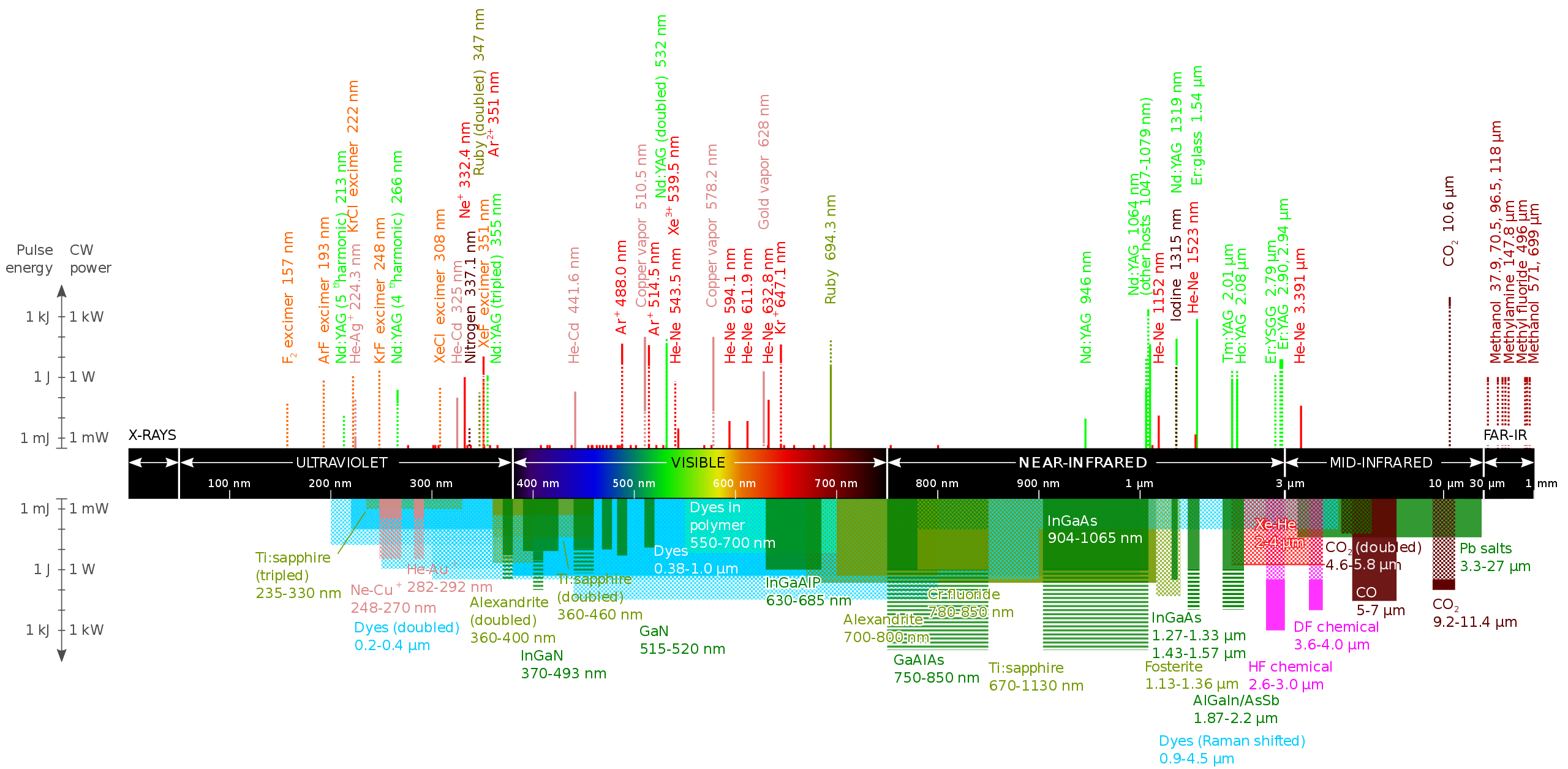
Your laser wavelength determines which glasses will protect you. Safety glasses are engineered to block specific wavelengths measured in nanometers, and they will not work if mismatched.
Identify Your Exact Laser Wavelength
Check the laser manual, serial plate, or manufacturer specifications for the precise emission wavelength. Common lasers include helium-neon at 632.8 nm, Nd:YAG at 1064 nm infrared or 532 nm green when frequency-doubled, CO2 lasers at 10,600 nm, diode lasers spanning 400 to 1550 nm, and argon-ion at 488 nm blue or 514 nm green. If your system emits multiple wavelengths, you need eyewear rated for all active lines through broad-spectrum filtering or dual-wavelength protection.
Verify Wavelength Coverage on Labels
Some glasses claim multi-laser protection, but always verify the exact wavelengths listed on the label. Protection at 532 nm does not mean protection at 1064 nm. Never assume coverage without checking the datasheet. In labs with multiple lasers, consult your Laser Safety Officer to ensure each device has matched eyewear.
Calculate the Optical Density You Need
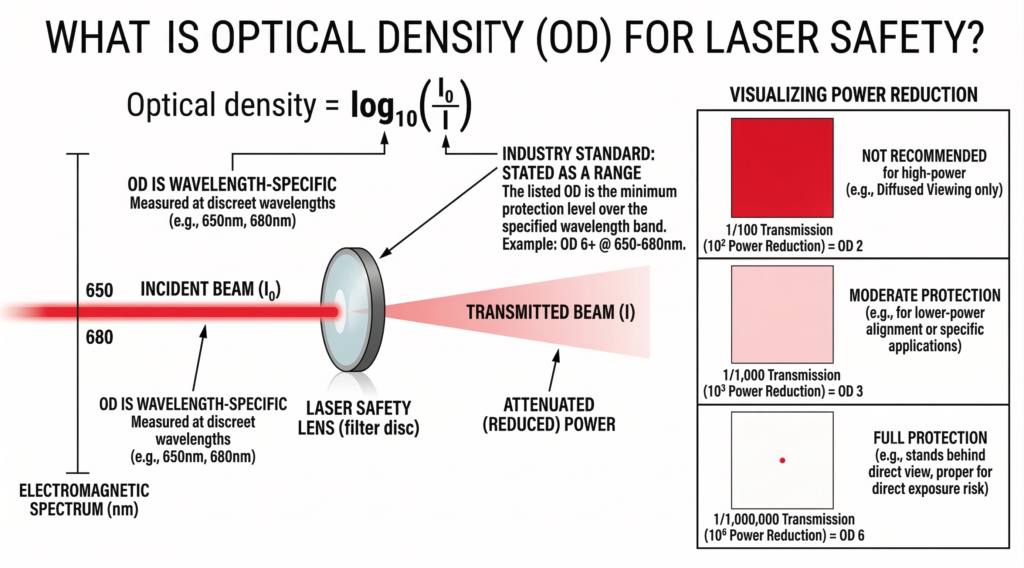
Optical density measures how much a lens reduces laser intensity. Higher optical density equals greater protection, and each level reduces beam power by a factor of 10.
Understand Optical Density Values
An optical density of 3 provides 1,000 times reduction, OD 4 provides 10,000 times, OD 5 provides 100,000 times, and OD 6 provides one million times reduction. For example, a one-watt laser hitting an OD 6 lens transmits only 0.001 mW, which falls below most maximum permissible exposure thresholds.
Determine Minimum Required Optical Density
Use ANSI Z136.1 guidelines or consult your Laser Safety Officer to calculate the needed optical density based on laser output power, exposure duration, beam divergence, and distance from source. As a general rule, Class 4 lasers typically require OD 4 to 7, medical and surgical lasers often need OD of 5 or higher, and alignment procedures may allow lower optical density if power is reduced. You can safely choose higher optical density than required for an added margin of safety.
Balance Protection with Visibility Using VLT
Visible light transmission measures how much ambient light passes through the lens, directly affecting visibility, color perception, and task performance.
Choose VLT Based on Your Work Environment
High VLT above 70 percent is ideal for dim lighting or detailed work like beam alignment. Medium VLT between 20 and 70 percent provides a good balance for general lab use. Low VLT below 20 percent is necessary for high-power lasers but may impair vision. A technician aligning a low-power beam under a microscope benefits more from high VLT than maximum optical density.
Compare VLT and Optical Density Together
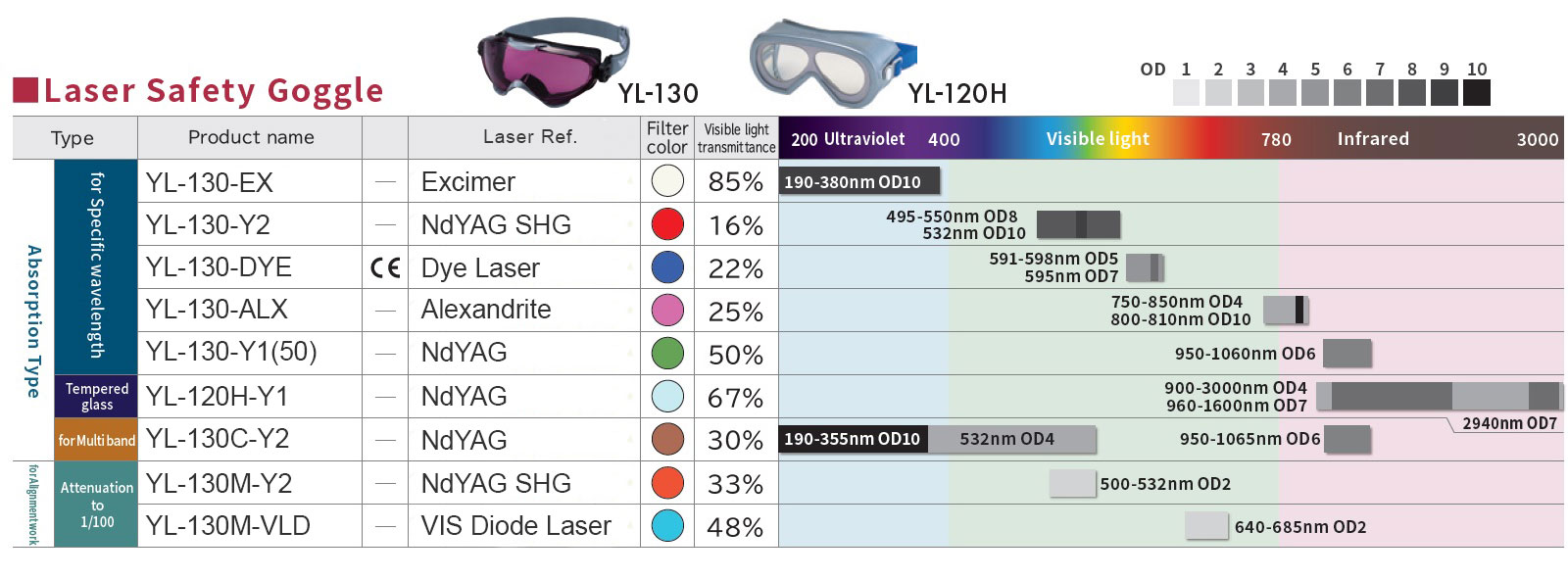
Manufacturers list both optical density and VLT at specific wavelengths. Always review both specifications. A lens with OD 6 at 1064 nm and 30 percent VLT may be usable, while one with OD 7 and 5 percent VLT might be too dark for extended wear. Prioritize usable protection that users will actually wear.
Select the Right Lens Material
Different materials offer trade-offs in protection, clarity, weight, and durability. Choose based on your specific application and power levels.
Glass Lenses for Maximum Protection
Glass lenses provide high optical density capability, excellent clarity, and resistance to heat and scratching. The downsides are heavier weight and less impact resistance compared to polycarbonate. Glass is ideal for high-power industrial, medical, or military applications where optical performance and thermal stability are critical.
Polycarbonate Lenses for Lightweight Durability
Polycarbonate lenses offer impact resistance, lightweight construction, and meet ANSI Z87.1 standards. The limitations are limited protection in mid- to far-infrared ranges and faster degradation under intense exposure. Polycarbonate is the go-to choice for educational labs, general research, and environments needing impact protection from flying debris.
Coated Lenses for Precision Filtering
Thin-film coated lenses use dielectric coatings to reflect specific wavelengths, achieving high optical density with better VLT. These are more expensive and sensitive to cleaning and handling. Coated lenses are best for multi-laser labs and R&D settings needing narrowband protection.
Ensure Proper Frame Fit and Coverage
Even the best lens fails if the frame leaves gaps for stray light to enter. Proper fit ensures full protection by eliminating exposure pathways.
Choose Wrap-Around or Side-Shielded Designs
Look for full peripheral coverage with integrated or attachable side shields and minimal gaps between lens and face. Wrap-around designs block reflections from the sides, which is a common hazard during alignment procedures.
Consider Over-the-Glasses Models for Prescription Wearers
For prescription wearers, over-the-glasses frames fit securely over regular glasses without compromising seal or comfort. Look for deep eye cups, adjustable temples, and non-slip nose pads. Adjustable bridges and temple arms improve comfort during extended procedures. Poor fit leads to slippage and increased risk.
Match Lens Color to Your Laser Type
Lens color is not cosmetic, it is engineered for specific wavelengths and visual performance. The right tint improves user compliance by reducing visual fatigue.
Use the Right Tint for Your Laser
Green lenses block red lasers such as HeNe at 632.8 nm and enhance red contrast in the work environment. Orange or amber lenses block blue lasers like argon-ion at 488 nm and reduce blue glare. Grey or neutral lenses work for broadband or multi-line lasers in mixed-laser environments while maintaining natural color view. Clear lenses block invisible infrared wavelengths such as 1064 nm while maintaining normal vision, which is a game-changer for Nd:YAG setups.
Avoid Incorrect Tints
Wearing green lenses for a blue laser offers little protection. Always match tint to the labeled wavelength, not just the visible beam color.
Accommodate Prescription Vision Needs
Vision correction should not compromise safety. Several options ensure clear vision while maintaining protection.
Prescription Laser Safety Glasses
Custom-made glasses with corrective power built into the protective lens offer no double eyewear, better optical alignment, and professional appearance. This option is ideal for full-time laser users, though it is more expensive.
Over-the-Glasses Models
Cost-effective over-the-glasses models work well for shared labs or occasional users. Ensure no light leakage around edges, stable fit over various frame sizes, and compatibility with common prescription styles. These promote compliance across teams with diverse vision needs.
Verify Safety Certifications and Labels
Certified glasses meet independent testing standards. Never skip this step. Fashion-style laser glasses sold online often lack real optical density ratings.
Look for Key Compliance Marks
ANSI Z136.1 defines maximum permissible exposure and safety practices in the United States. ANSI Z87.1 provides impact resistance, and look for the Z87+ marking for combined protection. CE Marking indicates conformity with European safety standards. EN 207 and EN 208 are specific to laser protection, with EN 207 for operational protection and EN 208 for alignment eyewear.
Check for Permanent Labeling
Frames should have permanent labeling listing wavelength protected, optical density at each wavelength, and applicable standard such as EN 207:2019. No label means no protection.
Inspect, Maintain, and Replace Regularly
Safety glasses degrade over time. Your protection should not be compromised by worn equipment.
Inspect Before Every Use
Check for scratches, cracks, or clouding on lenses. Inspect frames for warping or loose hinges. Ensure lenses are clean and free of smudges. Any defect requires immediate replacement.
Store Properly
Keep eyewear in a protective hard case away from direct sunlight, high heat, and chemical vapors. This prevents degradation of absorptive lenses. Replace absorptive lenses on schedule or after damage, typically every one to three years depending on use.
Integrate Eyewear into Your Full Safety Program
Eyewear is just one part of laser safety. A comprehensive approach ensures maximum protection.
Train All Users
Ensure everyone knows how to identify correct glasses for each laser, read optical density and wavelength labels, inspect and report damage, and respond to exposure incidents. Training boosts confidence and compliance.
Maintain an Eyewear Inventory
Log all laser systems, approved eyewear models, locations, and users. This enables quick audits and replacements. Define nominal hazard zones where eyewear is required and post signs restricting access to authorized personnel only.
Frequently Asked Questions About Choosing Laser Safety Glasses
How do I know which wavelength my laser uses?
Check the laser manual, serial plate, or manufacturer specifications for the exact emission wavelength. Common wavelengths include 632.8 nm for HeNe lasers, 1064 nm for Nd:YAG, and 10,600 nm for CO2 lasers. Consult your Laser Safety Officer if you are unsure.
What optical density do I need for a Class 4 laser?
Class 4 lasers typically require optical density between 4 and 7, depending on output power and exposure conditions. Use ANSI Z136.1 guidelines or consult your Laser Safety Officer to calculate the exact requirement for your specific setup.
Can I use one pair of glasses for multiple lasers?
Only if the glasses are rated for all wavelengths your lasers emit. Multi-wavelength protection glasses exist, but you must verify that the optical density is sufficient for each wavelength. Never assume one pair fits all situations.
How often should laser safety glasses be replaced?
Replace glasses immediately if damaged, scratched, or showing signs of degradation. Absorptive lenses typically last one to three years depending on use and storage conditions. Follow your Laser Safety Officer recommendations and conduct regular inspections.
Are clear lenses effective for infrared lasers?
Yes, clear lenses are specifically designed to block invisible infrared wavelengths like 1064 nm while maintaining normal visible vision. This allows you to see normally while staying protected from invisible beams.
What certification marks should I look for on laser safety glasses?
Look for ANSI Z136.1, ANSI Z87.1 (or Z87+), CE Marking, and EN 207 or EN 208. Permanent labeling should include wavelength protected, optical density at each wavelength, and the applicable standard. Never use eyewear without proper certification marks.
Key Takeaways for Choosing Laser Safety Glasses
Choosing laser safety glasses is a technical decision with real consequences for your vision. Follow these essential steps to ensure proper protection.
First, confirm your laser exact wavelength from the manual or manufacturer specs. Second, calculate required optical density using ANSI Z136.1 guidelines or LSO guidance. Third, balance optical density with visible light transmission for usable visibility in your work environment. Fourth, pick lens material based on power level and environmental needs, whether glass for high-power applications or polycarbonate for impact resistance. Fifth, ensure full coverage with wrap-around or side-shielded frames that fit securely. Sixth, match lens color to your laser type for optimal visibility. Seventh, verify certifications and permanent labeling before purchase. Eighth, train all users, inspect equipment regularly, and replace damaged eyewear immediately.
Never assume one pair fits all lasers. When in doubt, consult your Laser Safety Officer. The right glasses protect your vision, ensure compliance, and let you work safely without sacrificing performance. Choose wisely because your eyes depend on it.