How Fiber Lasers Work: Simple Guide
Imagine a cutting tool so precise it can drill holes in diamonds, yet so powerful it slices through thick steel like butter—all without touching the material. That’s the magic of a fiber laser. At the heart of modern manufacturing, medicine, and telecommunications, fiber lasers use light amplified within a hair-thin glass fiber to deliver unmatched efficiency and precision. But how does a fiber laser work? It starts with light amplification by stimulated emission of radiation, but in a form refined by decades of optical engineering.
This article breaks down exactly how this process unfolds, from the quantum dance inside doped glass to the industrial-grade output used in factories worldwide. You’ll learn the core physics, key components, operational modes, and real-world advantages that make fiber lasers the gold standard in laser technology today.
The Core Physics Behind Fiber Laser Operation
Stimulated Emission and Population Inversion
At the quantum level, how a fiber laser works begins with stimulated emission. When an electron in a rare-earth ion absorbs a pump photon, it jumps to a higher energy level. After a brief delay, it drops to a metastable state where it stays long enough to be triggered by another passing photon.
This trigger causes the electron to release a new photon identical in wavelength, phase, direction, and polarization. This is stimulated emission: one photon becomes two, then four, then thousands. For this chain reaction to dominate over random spontaneous emission, more electrons must be in the excited state than the ground state, a condition known as population inversion.
The key requirements for population inversion include intense pumping from laser diodes, efficient energy transfer within the doped fiber, and metastable state lifetimes long enough to build up excited electron populations.
Why Fiber Laser Output Differs from Ordinary Light
The output of a fiber laser isn’t just bright. It has fundamentally different properties that enable its precision capabilities:
The beam is monochromatic because all photons share nearly the same wavelength, thanks to spectral filtering by Fiber Bragg Gratings. It is coherent because photons are in phase, allowing them to constructively interfere and produce extreme intensities. It is collimated because the beam diverges very little, maintaining focus over long distances.
These properties enable fiber lasers to achieve energy densities exceeding gigawatts per square centimeter, making them ideal for melting or vaporizing materials with pinpoint accuracy.
Optical Fiber Structure and Light Guidance
Core, Cladding, and Coating Functions
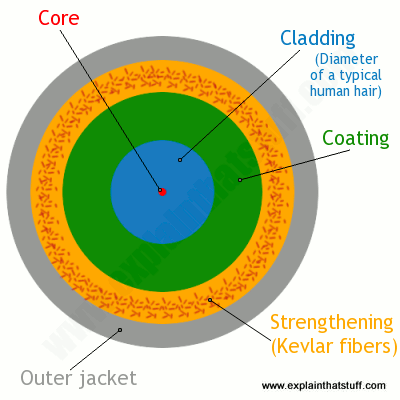
An optical fiber is not just a wire for light. It is a precision-engineered waveguide with three distinct layers:
The core is the central silica strand, doped with rare-earth ions, where signal light travels. It has a higher refractive index than the cladding. The cladding surrounds the core with a lower refractive index, enabling total internal reflection that traps light inside. The coating is a protective polymer layer, usually acrylate, that shields the glass from moisture, bending, and physical damage.
This layered design ensures low-loss transmission over meters or even kilometers while maintaining beam integrity throughout the fiber laser system.
Total Internal Reflection in Action
Light stays confined in the core due to Snell’s Law and the critical angle. When light hits the core-cladding boundary at a shallow angle, it reflects entirely back into the core instead of escaping.
This total internal reflection allows light to zigzag down the fiber with minimal loss, sometimes less than 0.2 dB per kilometer in telecom fibers. In fiber lasers, this principle guides both the pump light in the inner cladding and the laser signal in the doped core, ensuring efficient energy transfer and reliable beam delivery.
Double-Clad Fiber Design Explained
Inner and Outer Cladding Functions
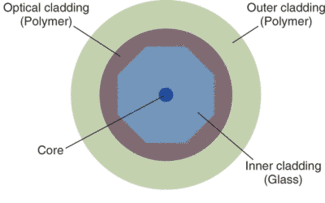
High-power fiber lasers use a double-clad fiber architecture to maximize efficiency and power output. The core is small, typically 5 to 10 micrometers, single-mode, and doped with rare-earth ions. It carries the laser signal.
The inner cladding, also called the pump cladding, is much larger at 100 to 400 micrometers, multimode, and carries pump light from laser diodes. The outer cladding is a polymer coating with an even lower refractive index that traps pump light via total internal reflection.
This design allows low-brightness, high-power multimode diodes to effectively pump a single-mode signal, enabling power scaling while preserving beam quality that would be impossible with traditional laser designs.
Shaped Claddings for Maximum Pump Absorption
A circular inner cladding leads to poor overlap between pump light and the doped core, reducing absorption efficiency. To fix this, manufacturers shape the inner cladding into octagonal, D-shaped, or rectangular profiles.
These geometric shapes increase the number of times pump light crosses the core, boosting absorption efficiency from less than 30 percent to over 90 percent in optimized designs. This innovation is key to building compact, high-efficiency fiber lasers without requiring exotic or ultra-bright pump sources.
How Pumping Creates Laser Light
Laser Diodes as the Energy Source
Fiber lasers rely on semiconductor laser diodes to convert electricity into optical pump light. Most operate at 915 nanometers or 976 nanometers, wavelengths carefully chosen to match the absorption peaks of ytterbium ions in the doped fiber.
Two main types of diodes are used in fiber laser systems. Single-emitter diodes offer high beam quality and long lifetime exceeding 100,000 hours, used in premium systems. Diode bars and stacks deliver higher total power but with lower beam quality and shorter lifespans, requiring active cooling.
These diodes are often arranged in modular arrays, allowing flexible power scaling and built-in redundancy for industrial applications.
From Electrical Energy to Optical Output
When current flows through a laser diode, electrons and holes recombine in the semiconductor junction, releasing photons. The diode’s cavity, formed by cleaved facets, provides feedback and amplifies this light into a directional beam.
This beam is then coupled into the fiber’s inner cladding using lenses or fused fiber combiners. Modern diodes convert 50 to 60 percent of electrical input into optical output, forming the first step in the fiber laser’s impressive wall-plug efficiency.
Rare-Earth Doping and Energy Transitions
Choosing the Right Dopant Ion
The dopant ions in the fiber core determine the laser’s wavelength and ideal applications. Ytterbium is the most common choice, emitting in the 1030 to 1100 nanometer range, typically 1064 nanometers, which is ideal for metal processing due to strong absorption.
Erbium emits around 1550 nanometers, is eye-safe, and is used in telecommunications and medical devices. Thulium emits in the 1800 to 2050 nanometer range and is well-absorbed by water and plastics, making it useful for surgery and polymer welding.
These ions are embedded in the silica glass during preform fabrication using solution doping or vapor doping techniques that ensure uniform distribution and long-term stability.
The Ytterbium Energy Level System
Ytterbium, the workhorse of industrial fiber lasers, has a simple yet efficient two-level system. The ground state absorbs 976 nanometer pump photons, exciting electrons to an excited state. These electrons rapidly relax to a metastable state.
Stimulated emission then brings them back to the ground state, emitting 1064 nanometer photons. Because there is no lower laser level above the ground state, self-termination is not an issue, enabling continuous-wave operation with high efficiency and reliability.
The Optical Cavity and Wavelength Control
Fiber Bragg Gratings as Built-In Mirrors
Unlike traditional lasers that use external mirrors, fiber lasers build their optical cavity directly into the fiber using Fiber Bragg Gratings. These are microscopic periodic changes in the fiber’s refractive index, created by exposing the fiber to ultraviolet laser light.
Two Fiber Bragg Gratings form the resonator. The high-reflectivity FBG reflects more than 99 percent of light at the lasing wavelength and is placed at the rear end. The output coupler FBG reflects only 10 to 20 percent, letting the rest escape as usable laser output.
This all-fiber cavity is robust, alignment-free, and highly stable, eliminating many of the maintenance issues found in traditional laser systems.
How Grating Period Selects Wavelength
The FBG reflects only a narrow band of wavelengths determined by its grating period. The reflected wavelength equals twice the product of the effective refractive index and the grating period.
By controlling the spacing of the index modulations, engineers can precisely tune the laser output wavelength, ensuring spectral purity and avoiding unwanted modes. This built-in filtering makes fiber lasers inherently single-wavelength and resistant to mode hopping during operation.
The Light Amplification Process
Building the Stimulated Emission Chain Reaction
Once population inversion is achieved, a single spontaneously emitted photon can ignite a cascade of stimulated emission. As it travels through the doped fiber, it encounters excited ions, each releasing another identical photon.
This process repeats over meters of fiber, turning a weak seed signal into a powerful beam. Because the fiber provides long interaction lengths, often 10 to 30 meters, even modest gain per unit length results in massive amplification.
The doped fiber acts as a traveling-wave amplifier, with light gaining strength continuously along its path through repeated stimulated emission events.
Exponential Growth of Coherent Photons
The amplification follows an exponential law where output intensity equals input intensity multiplied by e to the power of gain coefficient times distance. With sufficient pump power and fiber length, gains of 30 to 60 decibels are achievable.
Because only photons matching the FBG wavelength are reflected and amplified, the output remains narrow-linewidth and spatially coherent, essential for precision cutting, welding, and marking applications.
Beam Delivery and Focusing Systems
Flexible Fiber Optic Output Advantages
One of the biggest advantages of fiber lasers is beam delivery via flexible cable. Unlike carbon dioxide lasers that require mirrors and precise alignment, the laser beam travels from the source to the processing head through a bend-insensitive fiber.
This flexibility allows integration into robotic arms, gantries, and automated production lines, making fiber lasers ideal for dynamic industrial environments where the laser source may need to move or where complex beam paths are required.
From Fiber Output to Focused Spot
At the processing head, the diverging beam from the fiber undergoes conditioning. First, a collimating lens makes the beam parallel. Then a beam expander increases the diameter to reduce divergence. Finally, a focusing lens concentrates the beam into a 20 to 100 micrometer spot.
This concentrated spot achieves power densities high enough to melt steel and other metals. Lenses are typically made of fused silica for 1064 nanometer light or zinc selenide for mid-infrared wavelengths.
Types of Fiber Laser Operation Modes
Continuous Wave vs. Pulsed Fiber Lasers
Fiber lasers operate in several modes depending on the application. Continuous wave mode provides a steady beam for welding, cutting, and heat treatment applications where consistent power delivery is essential.
Pulsed mode delivers short bursts for marking, engraving, and cleaning where rapid energy delivery in short durations improves material interaction. Quasi-continuous wave mode offers long pulses in the millisecond range for deep welding with high penetration.
Ultrafast modes generate picosecond or femtosecond pulses for cold ablation and precision micro-machining where thermal damage must be minimized.
Q-Switched vs. MOPA Laser Configurations
Q-switched fiber lasers use an acousto-optic modulator to block the cavity, storing energy before releasing a 100 to 200 nanosecond pulse with tens of kilowatts peak power. This configuration is ideal for marking and cleaning but offers limited pulse control.
MOPA fiber lasers separate pulse generation from amplification. This architecture offers adjustable pulse width from 2 to 500 nanoseconds, frequencies up to 4 megahertz, and custom pulse shapes. MOPA systems enable color marking on stainless steel and burn-free plastic engraving, outperforming Q-switched systems in versatility.
Performance Metrics and Efficiency Ratings

Understanding Beam Quality Measurements
Two key metrics define how well a fiber laser can focus its beam. M-squared measures deviation from a perfect Gaussian beam, with a value of 1 being perfect. Industrial fiber lasers achieve M-squared less than 1.3, often less than 1.1.
The beam parameter product combines beam radius and divergence in units of millimeter-milliradians. Lower BPP equals tighter focus and better beam quality. High beam quality enables fine cutting and deep keyhole welding, while lower quality suits cladding or heat treatment applications.
Why Fiber Lasers Are So Efficient
Fiber lasers convert 30 to 50 percent of electrical input into optical output, far exceeding carbon dioxide lasers at 10 to 15 percent and Nd:YAG lasers at 3 to 5 percent. This high efficiency comes from efficient diode pumping, low thermal load due to the fiber’s high surface-to-volume ratio, and minimal losses in the all-fiber design.
Even with 50 percent heat generation, advanced cooling systems keep temperatures stable during continuous operation in industrial environments.
Industrial and Medical Applications
Metal Cutting and Welding with Fiber Lasers
Fiber lasers dominate sheet metal fabrication, cutting steel up to 30 millimeters thick at speeds far exceeding carbon dioxide lasers, especially on thin metals. Their 1064 nanometer wavelength is highly absorbed by metals, enabling efficient energy transfer into the workpiece.
In automotive and battery manufacturing, fiber lasers perform deep-penetration keyhole welding with minimal distortion, creating strong welds while minimizing heat-affected zones.
Marking, Engraving, and Surface Cleaning
Pulsed fiber lasers create permanent marks on metals, plastics, and ceramics. MOPA systems allow color marking on stainless steel by precisely controlling the oxide layer thickness through carefully tuned pulse parameters.
Laser cleaning removes rust, paint, and oxides without abrasives, making it ideal for restoration work and surface preparation before welding or coating applications.
Medical Applications of Fiber Lasers
Thulium fiber lasers at 1940 nanometers are used in urology and dermatology due to strong water absorption in tissue. Femtosecond fiber lasers enable corneal surgery and multiphoton microscopy for advanced medical procedures.
Erbium-doped fiber amplifiers boost signals in long-haul telecommunications networks, keeping the internet running at full speed across continents.
Safety and Maintenance Requirements
Understanding Laser Hazards
The invisible near-infrared beam at 1064 nanometers poses serious safety risks. It can cause retinal burns even from scattered reflections and may ignite flammable materials.
Proper safety measures include laser safety glasses with optical density 5 or higher at 1064 nanometers, interlocked enclosures rated Class 1, and beam dumps and shutters to contain the beam when not in use.
Minimal Maintenance for Maximum Uptime
Fiber lasers have no mirrors to align, no gases to refill, and no flashlamps to replace. Typical maintenance includes cleaning protective windows and focusing lenses, inspecting fiber connectors, and checking cooling system performance.
With mean time between failures ratings up to 100,000 hours, fiber lasers offer exceptional uptime and reliability in demanding industrial environments.
Frequently Asked Questions About Fiber Lasers
How does a fiber laser generate light compared to other laser types?
A fiber laser generates light through stimulated emission within a rare-earth-doped optical fiber, unlike carbon dioxide lasers that use gas mixtures or Nd:YAG lasers that use crystal rods. The fiber itself serves as both the gain medium and the waveguide, allowing for efficient light generation and delivery in a single integrated system.
What makes fiber lasers more efficient than CO2 lasers?
Fiber lasers achieve 30 to 50 percent wall-plug efficiency compared to 10 to 15 percent for carbon dioxide lasers. This efficiency comes from direct diode pumping of the doped fiber, low optical losses in the fiber waveguide, and the all-fiber design that eliminates free-space optics and associated losses.
Can fiber lasers cut all types of materials?
Fiber lasers excel at cutting metals due to strong absorption at 1064 nanometers. They are less effective on non-metals like wood or acrylic, which absorb carbon dioxide laser wavelength better. For non-metals, thulium fiber lasers operating near 2000 nanometers offer improved absorption in plastics and organic materials.
How long do fiber laser components last?
Pump diodes and the doped fiber can last over 100,000 hours mean time between failures when properly maintained. This lifespan far exceeds traditional laser systems that require flashlamp replacement every 1,000 to 5,000 hours or carbon dioxide tubes every 30,000 hours.
What is the difference between Q-switched and MOPA fiber lasers?
Q-switched lasers use an internal modulator to store and release energy in fixed pulses, typically 100 to 200 nanoseconds. MOPA lasers separate the seed pulse generator from the power amplifier, offering adjustable pulse width, frequency, and shape for greater versatility in marking and engraving applications.
Key Takeaways for Understanding Fiber Laser Technology
From quantum transitions in doped glass to kilowatt beams shaping the modern world, fiber lasers exemplify the fusion of physics and engineering. Their operation relies on stimulated emission within rare-earth-doped optical fibers, pumped by efficient semiconductor diodes and resonating through Fiber Bragg Gratings that serve as built-in mirrors.
The double-clad fiber design enables high-power operation by coupling pump light through a large inner cladding while the signal propagates in a small single-mode core. This architecture, combined with the flexibility of fiber optic beam delivery, makes fiber lasers ideal for automated manufacturing environments.
Their efficiency, precision, and durability have made fiber lasers indispensable across industries, from metal cutting and welding to medical procedures and telecommunications. The combination of high beam quality, low maintenance requirements, and long component life continues to drive adoption across every sector that relies on precision laser technology.