
How Far Does a Laser Pointer Reach: Explained
Have you ever shined a laser pointer into the night sky and wondered if someone on a distant hill could see it? The answer is not as simple as the number on the label. While a laser beam technically travels forever in a vacuum, how far it can be seen depends on power, color, atmospheric conditions, and what you are aiming at. A typical 5mW green laser pointer can produce a visible beam up to 1.6 kilometers under dark skies, though its light continues far beyond that point. This guide breaks down exactly how far laser pointers reach, what limits their visibility, and why even a small pen-sized device has surprising implications when physics and optics collide.
Output Power: The Primary Factor in Laser Range
The strength of a laser, measured in milliwatts, directly determines how far its beam can be seen. Most consumer laser pointers range from 1 to 5mW and are designed for presentations and short-range use. These low-power lasers remain visible over long distances at night under the right conditions.
A 5mW green laser produces a beam detectable up to 1.6km under clear, dark skies. At aircraft cruising altitudes around 12km, the beam appears about as bright as moonlight, which is enough to distract or temporarily impair pilots. This is why pointing lasers at aircraft is illegal in most countries.
Lasers between 20 and 50mW are popular among astronomers for stargazing. They generate a beam visible for 5 to 8km, especially when light scatters off atmospheric particles. At 100mW, the beam can stretch over 16km, making it useful for surveying or long-range signaling. However, lasers above 5mW are regulated in many regions due to eye safety risks.
Why Green Lasers Reach Farther Than Red and Blue
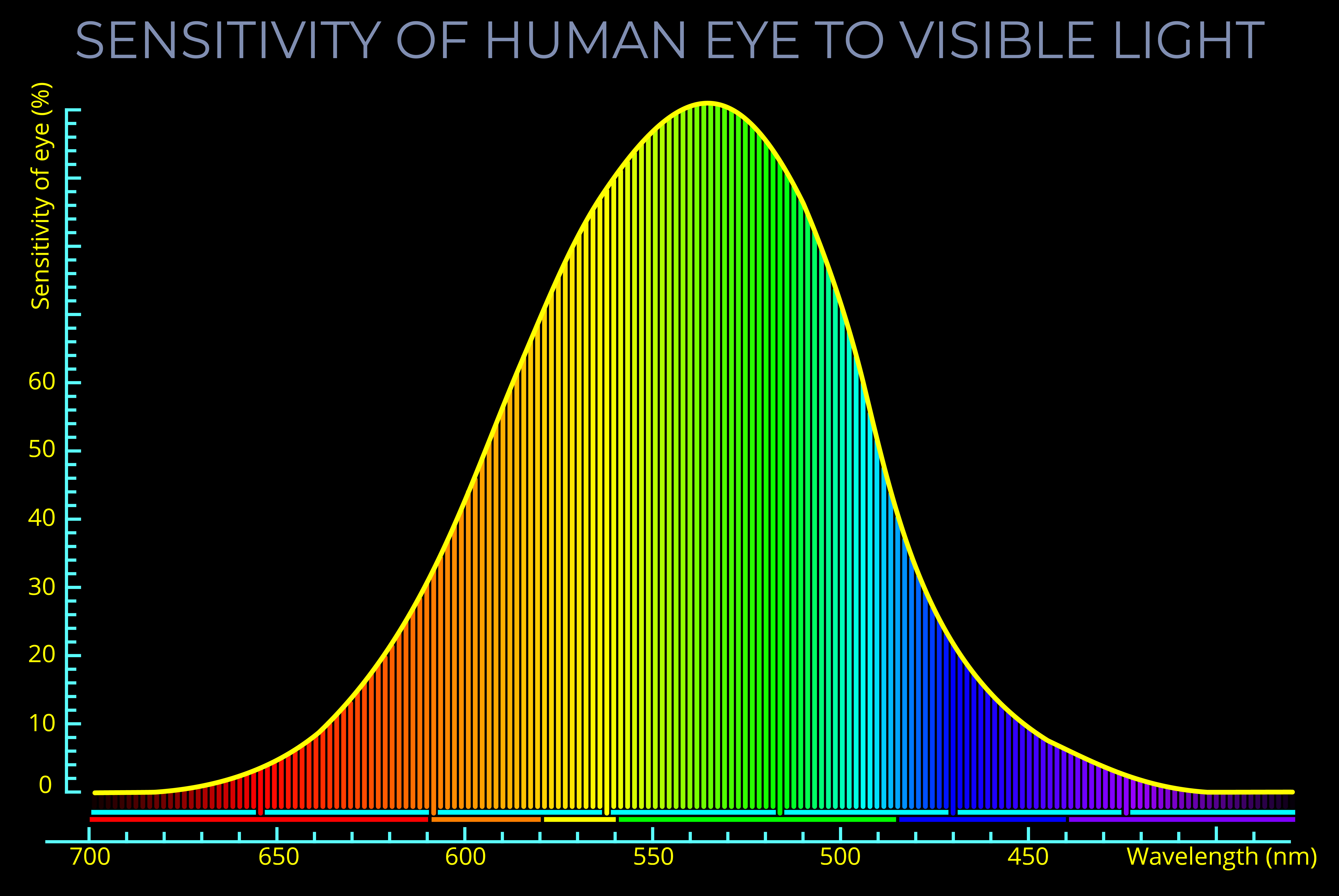
Not all colors are equal when it comes to visibility. The human eye is most sensitive to green light at 532nm, making green lasers appear 4 to 6 times brighter than red or blue lasers of the same power. This is why green pointers dominate astronomy and outdoor use.
Green lasers excel because they match peak sensitivity in both daylight and low-light vision conditions. Red lasers at 650 to 670nm are less visible, especially at distance, and their beams often disappear beyond 800 meters. Blue lasers at 450nm are moderately bright but less efficient for night use due to lower eye sensitivity.
Even a 5mW green laser can outshine a 10mW red one in real-world conditions. For maximum visibility after dark, green remains the clear winner.
How Beam Divergence Limits Laser Distance
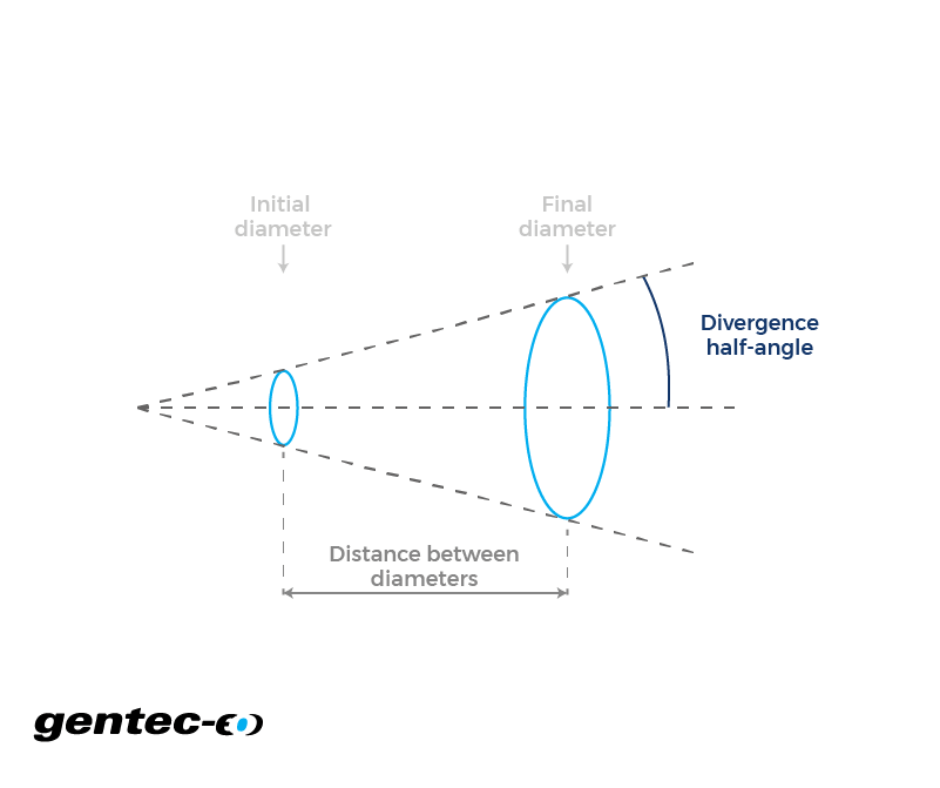
All laser beams diverge, or spread out, as they travel. This divergence, measured in milliradians, determines how tightly the beam stays focused. Most consumer lasers have a divergence of 1.0 to 2.0mrad, meaning the beam widens by 1 meter per kilometer of travel.
At 1km, a 1mrad beam is approximately 1 meter wide. At 10km, it is about 10 meters wide. At the Moon, 384,400km away, the same beam would cover over 12km in diameter, spreading the energy so thin it becomes invisible without sensitive instruments.
High-end lasers used in lunar ranging experiments use large optics to reduce divergence to 0.1mrad or less, creating a spot only about 2.4km wide on the lunar surface. This is still undetectable to the naked eye but sufficient for scientific detection via retroreflectors left by Apollo missions.
The Inverse Square Law and Laser Intensity

Even without divergence, laser intensity drops rapidly due to the inverse square law. Brightness decreases with the square of the distance. A beam that is bright at 1 meter becomes one-fourth as bright at 2 meters, one-hundredth at 10 meters, and one-ten-thousandth at 100 meters.
Combined with beam spread, this means a 5mW laser loses over 99.99% of its intensity within the first kilometer. While photons keep traveling, they become too sparse to see or detect without amplification.
This is why even powerful lasers fade into invisibility over interplanetary distances. Energy disperses faster than it can be concentrated.
How Weather Affects Laser Visibility
Atmospheric conditions drastically reduce laser reach. Fog, rain, snow, and smoke scatter and absorb light, limiting visibility to just a few hundred meters even for high-power lasers. Water droplets and particulates cause Mie scattering, which diffuses the beam and creates a glowing halo effect near the source while cutting off long-distance transmission.
On a foggy night, a 100mW laser may only be visible for 300 meters. On a clear, dry desert night, the same beam could stretch 10km or more.
The best conditions for long-range laser visibility are pitch-black skies, low humidity, minimal air pollution, and no ambient light far from cities. Under these conditions, Rayleigh scattering allows the beam path itself to become visible, especially with green lasers.
Clouds can also extend apparent range by reflecting and diffusing laser light. A laser aimed at a cloud layer 2km away may appear to stop there, but the scattered glow can be seen from miles away, creating the illusion of a longer beam.
Laser Range in Real-World Scenarios
A 5mW green laser aimed at a white wall or reflective surface 10km away may produce a faint spot visible with binoculars or night-vision gear. The unaided eye might detect it under perfect darkness, especially if the beam passes through slightly dusty air.
With a 100mW laser, the beam path becomes clearly visible for 8 to 16km, and the dot can be seen on buildings, mountains, or clouds at similar distances. This makes high-power lasers useful for surveying, search-and-rescue signaling, and military targeting.
A 5mW laser aimed at an aircraft at 12km altitude delivers a beam comparable in brightness to moonlight. While this sounds dim, it can cause glare, flashblindness, and temporary vision disruption in a dark cockpit. Even brief exposure can endanger flight safety.
Can a Laser Reach the International Space Station
The ISS orbits approximately 400km above Earth. A 5mW green laser beam reaching that altitude would be as bright as Sirius, the brightest star in the night sky. While astronauts would not see it with the naked eye, sensitive cameras or sensors could detect it, especially if pulsed in a coded pattern.
However, atmospheric turbulence, cloud cover, and beam spread make consistent detection unlikely with consumer equipment. Only high-power, stabilized systems with narrow divergence can reliably send detectable signals to low Earth orbit satellites.
Scientists routinely bounce lasers off the Moon using Apollo retroreflector arrays. But they use gigawatt-pulsed lasers with telescope-sized optics and ultra-low divergence beams. These systems fire short bursts that spread to about 2km in diameter on the lunar surface.
A 5mW consumer laser would create a spot over 12km wide on the Moon so dim that not a single photon would likely be detected back on Earth.
Military and Scientific Lasers: Extreme Range Examples
The U.S. Navy Laser Weapon System operates at 500,000 watts, which is 100 million times stronger than a 5mW pointer. It emits invisible infrared light designed to destroy drones and missiles at close range. While not meant for visibility, its beam could create a 2.4km-wide spot on the Moon.
Facilities like the National Ignition Facility use petawatt lasers focused into femtosecond pulses on microscopic targets. These lasers achieve intensities 10 trillion times brighter than the Sun’s surface and are used for nuclear fusion research and quantum physics experiments.
Laser Safety and Legal Limits You Must Know
Lasers are classified by risk. Class 2 lasers at 1mW or less are safe for brief exposure and common in red pointers. Class 3R lasers at 1 to 5mW have low risk if used carefully and include most green pointers. Class 3B lasers above 5mW can cause eye injury instantly. Class 4 lasers above 500mW are fire hazards requiring safety training and protective gear.
Most countries limit consumer lasers to 5mW. Higher-powered units require permits and are banned in public spaces.
Even a 5mW laser can cause retinal damage if viewed directly. At arm is length, the retinal image can be 30 times brighter than the Sun. Always avoid pointing at faces, never look directly into the beam, and use only in controlled environments.
Pointing lasers at aircraft is a federal crime in the U.S. and many other countries, punishable by fines up to $250,000 and prison terms up to 5 years.
Frequently Asked Questions About Laser Pointer Range
Can a 5mW laser be seen from 1 mile away?
Yes. Under clear, dark skies, a 5mW green laser pointer can produce a beam visible up to 1.6km or about 1 mile. The actual spot on a surface may be harder to see at that distance, but the beam path itself remains visible.
Why do green lasers appear brighter than red ones?
The human eye is most sensitive to green light at 532nm. This wavelength matches peak sensitivity in both photopic and scotopic vision, making green lasers appear 4 to 6 times brighter than red lasers of identical power output.
Does a laser beam ever stop traveling?
No. In a vacuum, laser light travels indefinitely. However, the beam spreads out and its intensity drops according to the inverse square law, making it invisible to human eyes or detectable instruments beyond a certain distance.
Can a laser pointer reach the Moon?
Not with consumer equipment. A 5mW laser would create a spot over 12km wide on the lunar surface, far too dim to see. Scientists use gigawatt-pulsed lasers with large telescopes to bounce light off Apollo retroreflectors.
Are high-power lasers legal to own?
Laws vary by country. Most nations restrict consumer lasers to 5mW or less. Lasers above that power often require permits, safety training, and restricted use. Pointing any laser at aircraft is illegal in most countries.
What is the farthest a laser has been detected?
Scientists have bounced lasers off the Moon from Earth, a distance of approximately 384,400km. This requires specialized equipment, not standard laser pointers.
Key Takeaways for Understanding Laser Pointer Range
A laser pointer beam travels indefinitely in space, but visibility ends quickly due to physics and biology. Under ideal conditions, a 5mW green laser reaches 1.6km to the naked eye, with detectable light extending much farther under perfect darkness. High-power lasers above 50mW can project visible beams over 16km, but interplanetary visibility remains impossible for consumer devices.
Beam divergence, atmospheric conditions, and the inverse square law all work together to limit how far you can actually see a laser pointer. Green lasers outperform red and blue because they match human eye sensitivity. Always use lasers responsibly, never point them at aircraft or people, and understand the legal limits in your area.