How Laser Doppler Vibrometers Work: The Science Behind Non-Contact Vibration Measurement
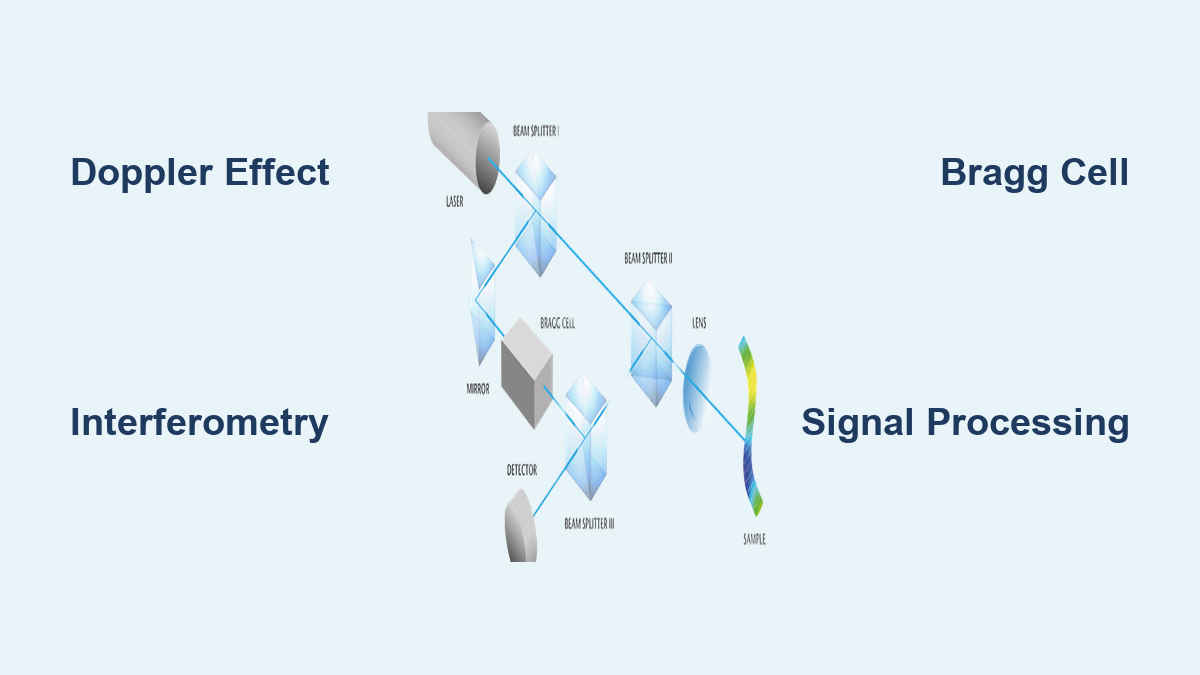
Imagine measuring vibrations so tiny they are smaller than the width of an atom without touching the surface at all. That is exactly what a laser Doppler vibrometer does. This high-precision optical instrument measures the velocity and displacement of vibrating surfaces using only a beam of light, making it indispensable in fields ranging from micro-electromechanical systems research to aerospace engineering. The technology combines two powerful principles: the Doppler effect and laser interferometry, achieving resolution down to femtometers across frequencies from 0 Hz all the way up to 8 GHz.
In this guide, you will learn exactly how a laser Doppler vibrometer works, from the physics behind the Doppler shift to signal processing, measurement modes, and real-world applications where this technology shines.
The Doppler Effect: The Foundation of LDV Operation
The key to understanding how a laser Doppler vibrometer works lies in the Doppler effect, the same phenomenon that makes a siren sound higher-pitched as it approaches and lower as it moves away.
How Frequency Shift Reveals Velocity
When a coherent laser beam strikes a vibrating surface, the reflected light undergoes a frequency shift that depends on how fast the surface moves toward or away from the sensor. This Doppler frequency shift is calculated using the formula:
fD = 2v/λ cosθ
Where v represents surface velocity in meters per second, λ is the laser wavelength, and θ is the angle between the laser beam and the direction of motion. For normal incidence where the laser points directly at the vibrating surface, cosθ equals 1, simplifying the calculation.
The direct proportionality between frequency shift and velocity means the LDV can measure motion in real time with exceptional linearity and accuracy. This mathematical relationship is what makes the laser Doppler vibrometer such a powerful measurement tool.
Why Light Outperforms Sound for Vibration Measurement
While the Doppler effect applies to both sound and light, laser Doppler vibrometers use light because it offers decisive advantages. Light travels at approximately 3 × 10⁸ meters per second, enabling detection of ultra-fast vibrations that sound simply cannot track. Additionally, lasers produce highly coherent and monochromatic light, allowing interference-based measurements with extraordinary precision.
The non-contact nature of this approach is equally important. Unlike accelerometers that must be physically attached to a surface, a laser Doppler vibrometer requires no mounting and adds no mass to the system under test. This makes it ideal for testing lightweight structures like eardrums, silicon chips, or thin composite panels where even a tiny sensor would distort the results.
Interferometric Detection: Converting Light Into Measurable Signals
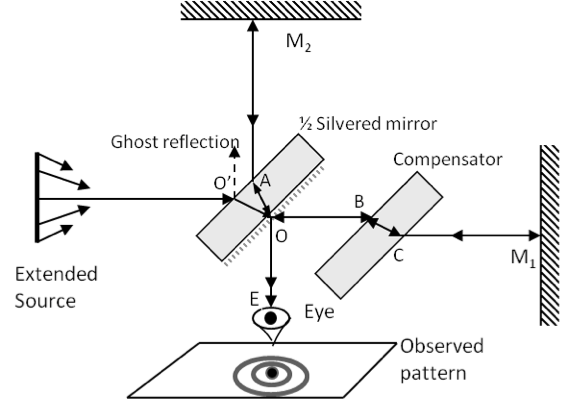
Detecting the tiny frequency shifts caused by surface vibrations requires more than a simple photodetector. Laser Doppler vibrometers use optical interferometry to convert phase changes in reflected light into electrical signals that can be analyzed.
How Interferometers Extract Vibration Data
Most laser Doppler vibrometers employ either a Mach-Zehnder or Michelson interferometer configuration. The process works as follows. First, a laser beam is split into two paths: a reference beam that travels a fixed internal distance and a measurement beam that directed to the target surface. The measurement beam reflects off the vibrating surface and returns to the detector where it recombines with the reference beam, creating an interference pattern.
The intensity at the photodetector follows this relationship:
Itot = I1 + I2 + 2√(I1I2) cos(2π(r1 – r2)/λ)
Where r1 changes with surface motion and r2 remains constant. As the target vibrates, r1 varies continuously, causing cyclic changes in phase that produce a beat signal tied directly to surface displacement.
Understanding Fringe Counts and Resolution
Each complete interference cycle, called a fringe, corresponds to a displacement of exactly half the laser wavelength. For a helium-neon laser operating at 632.8 nm, one fringe equals 316.4 nanometers of displacement. For short-wave infrared lasers at 1550 nm, one fringe equals 775 nanometers.
By counting fringes and interpolating between them, laser Doppler vibrometers achieve sub-picometer resolution, far exceeding what any mechanical sensor can accomplish. This explains why the technology can detect motions smaller than atomic dimensions.
The Bragg Cell: Enabling Directional Sensitivity
A basic interferometer cannot distinguish between motion toward or away from the sensor because both produce identical fringe rates. To solve this problem, laser Doppler vibrometers incorporate a Bragg cell, also known as an acousto-optic modulator.
How Heterodyne Detection Resolves Direction
The Bragg cell sits in the reference beam path and shifts its frequency by exactly 40 MHz. When the target is stationary, the photodetector sees a carrier signal at 40 MHz from the interference between the shifted reference and unshifted return beam. When the surface moves, the situation changes dramatically. Motion toward the sensor increases the reflected frequency, producing an output greater than 40 MHz. Motion away decreases the frequency, yielding an output below 40 MHz.
This heterodyne detection scheme allows the laser Doppler vibrometer to determine not only how fast something is vibrating but also which direction it is moving. Without this capability, bidirectional vibration analysis would be impossible.
Signal Processing: From Light Waves to Engineering Data

Raw interference signals are not useful until they are converted into engineering units. Modern laser Doppler vibrometers use advanced digital signal processing to extract usable vibration data.
The Demodulation Chain Explained
The signal processing pipeline works in several stages. First, the photodetector converts the interference pattern into a time-varying voltage signal centered around 40 MHz. Next, digital circuits isolate the Doppler shift component using techniques like digital phase-locked loops or FFT-based tracking, with sampling rates reaching up to 160 megasamples per second.
Since the Doppler frequency directly relates to velocity through the equation fD = 2v/λ, the system computes instantaneous velocity in real time. This velocity measurement represents the primary output of a laser Doppler vibrometer, with all other quantities derived from it.
Displacement calculation requires either integrating velocity over time or counting fringes with phase interpolation. The integration method works well at high frequencies, while fringe counting is preferred for low frequencies where drift becomes problematic. Acceleration, when needed, comes from differentiating velocity, though this approach amplifies noise and is rarely used.
Measurement Modes: Choosing the Right Configuration

Laser Doppler vibrometers come in several configurations tailored to different applications, each offering distinct advantages.
Single-Point LDV for Targeted Measurements
Single-point laser Doppler vibrometers measure vibration at one location only. This mode is ideal for quality assurance on production lines, targeted diagnostics, and verifying modal nodes in specific areas. The advantages include fast setup, high signal-to-noise ratio, and minimal data processing requirements.
Compact units like the Optomet SMART Single+ provide industrial-grade performance for real-time monitoring in factory environments where precision matters but full-field scanning is unnecessary.
Scanning LDV for Full-Field Analysis
Scanning laser Doppler vibrometers use galvanometer mirrors to raster the laser beam across a surface automatically, measuring hundreds or thousands of points to build complete vibration maps. This capability reveals complex mode shapes and operational deflection shapes that single-point measurements cannot capture.
This mode excels in automotive noise-vibration-harshness testing, loudspeaker diaphragm analysis, and aerospace panel testing where understanding how an entire structure responds to vibration is essential.
Parallel Multi-Point Systems for Ultra-Fast Capture
Next-generation systems like Ommatidia Q1 and Q2 use photonic chip arrays to measure dozens of points simultaneously. The Q1 system captures up to 128 points in parallel while the Q2 handles 65 points. These systems combine 3D geometry scanning, surface profiling, and vibration measurement in a single pass, ensuring perfect co-registration between shape and dynamics.
These configurations excel at capturing transient events like impacts, testing rotating components, and performing high-throughput industrial inspection where speed matters.
Performance Specifications and Capabilities
Laser Doppler vibrometers offer extraordinary specifications that set them apart from contact sensors. Displacement resolution reaches femtometers, meaning they can detect motions smaller than an atom. Velocity resolution falls below micrometers per second. The frequency range spans from DC (0 Hz) all the way to 8 GHz for specialized systems.
Working distances extend from millimeters up to 21 meters for remote applications like bridge monitoring. Dynamic range exceeds 120 dB on high-end models. These capabilities make laser Doppler vibrometers the most accurate vibration measurement tools available anywhere.
Advantages Over Traditional Contact Sensors
The benefits of non-contact measurement transform what engineers can accomplish. Without mass loading, delicate structures behave naturally without sensor-induced alterations. Ultra-high resolution reveals vibration patterns invisible to accelerometers. The wide bandwidth captures everything from slow structural oscillations to ultrasonic frequencies.
Remote operation allows measurement of hot surfaces, rotating components, and hazardous locations that would be dangerous or impossible to access with contact sensors. Full-field scanning with SLDV reveals complex mode shapes across entire structures without the tedious process of moving individual sensors.
Directional sensitivity through Bragg cell heterodyning provides clear motion direction, while the lack of mounting requirements means point-and-measure simplicity. Long-term stability avoids sensor wear and calibration drift that afflicts contact instruments over time.
Limitations and Practical Challenges
Despite their power, laser Doppler vibrometers have constraints that users must address. Line-of-sight requirements mean direct optical access is necessary, making shadowed or internal components difficult or impossible to measure.
Surface reflectivity presents challenges. Low-reflectivity surfaces like black rubber or matte finishes return weak signals, often requiring application of retroreflective tape or specialized coatings to enhance return signal strength.
Environmental sensitivity affects performance. Air turbulence, dust, and thermal gradients disrupt interference patterns, requiring optical tables, enclosures, or active stabilization in sensitive measurement environments. Ambient light interference from sunlight affects visible-wavelength systems, though short-wave infrared lasers at 1550 nm reduce this problem significantly.
Cost remains higher than accelerometers, and scanning systems generate large datasets requiring specialized software expertise to analyze effectively.
Applications Across Industries
Laser Doppler vibrometers serve critical roles across numerous sectors. In MEMS and microelectronics, they characterize micro-motors, gyroscopes, and RF switches while validating finite element models. In biomedical research, they map eardrum vibrations and test hearing aids without invasive procedures.
Structural health monitoring uses these instruments to detect cracks and fatigue through vibration signature changes on bridges, dams, and wind turbines. Automotive engineers rely on them for noise-vibration-harshness diagnosis and quality assurance. Aerospace applications include ground vibration testing of aircraft and non-contact modal analysis of composite panels.
Industrial machinery monitoring detects imbalance, misalignment, and bearing wear before failures occur. The versatility of laser Doppler vibrometry continues expanding into new applications as technology advances.
Frequently Asked Questions About Laser Doppler Vibrometers
What is the basic operating principle of a laser Doppler vibrometer?
A laser Doppler vibrometer works by directing a laser beam at a vibrating surface and analyzing the frequency shift in the reflected light caused by the Doppler effect. This frequency shift is directly proportional to surface velocity, allowing the instrument to calculate velocity and displacement without any physical contact.
What makes laser Doppler vibrometers so accurate?
The combination of laser interferometry and digital signal processing enables extraordinary resolution. Each interference fringe corresponds to just half a wavelength of displacement, and modern systems can interpolate between fringes to achieve femtometer-level resolution. The coherent nature of laser light allows precise phase measurement impossible with other light sources.
Can a laser Doppler vibrometer measure in any direction?
A laser Doppler vibrometer measures motion along its line of sight only. The Bragg cell enables the instrument to distinguish between motion toward and away from the sensor, but it cannot detect motion perpendicular to the laser beam. Multiple viewing angles are required to reconstruct three-dimensional vibration patterns.
What surfaces can be measured with a laser Doppler vibrometer?
Any surface that reflects enough light back to the detector can be measured. Metallic surfaces and retroreflective materials work best. Rough, dark, or matte surfaces may require reflective tape or coatings to enhance signal return. The surface must be accessible to the laser beam with a clear line of sight.
How does a scanning LDV create vibration maps?
A scanning laser Doppler vibrometer uses galvanometer-mounted mirrors to steer the laser beam across a surface in a programmed pattern. At each measurement point, the system records vibration data. The resulting dataset creates full-field vibration maps that can be animated to show mode shapes and operational deflection patterns.
What are the main advantages over accelerometers?
Laser Doppler vibrometers offer non-contact measurement with zero mass loading, femtometer resolution, DC-to-GHz bandwidth, and full-field mapping capability. Accelerometers remain practical for routine field monitoring due to lower cost and ruggedness, but LDVs dominate in precision research, delicate structure testing, and applications requiring non-invasive measurement.
Key Takeaways for Understanding Laser Doppler Vibrometers
A laser Doppler vibrometer works by combining the Doppler effect with laser interferometry to measure surface vibrations with unmatched precision. The technology detects frequency shifts in reflected laser light caused by moving surfaces, converting these shifts into velocity and displacement data without any physical contact.
The Bragg cell enables directional sensitivity through heterodyne detection, while advanced digital signal processing delivers real-time measurements with femtometer resolution across frequencies from DC to 8 GHz. Single-point, scanning, and parallel multi-point configurations serve different applications, from quality assurance to full-field modal analysis.
Despite higher cost and environmental sensitivity compared to accelerometers, laser Doppler vibrometers provide indispensable capabilities for precision research, structural health monitoring, and advanced engineering diagnostics where non-contact measurement and maximum accuracy are essential.